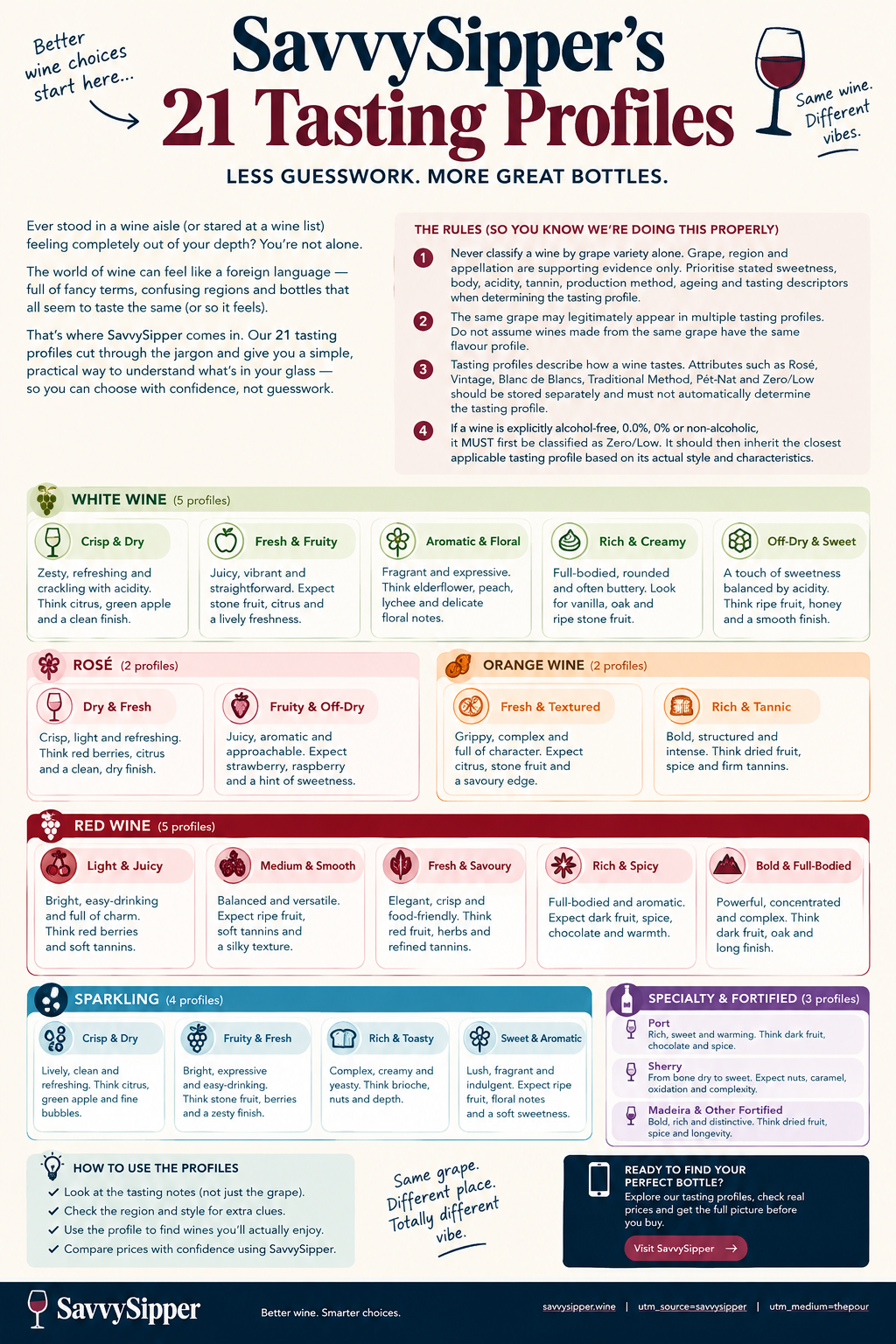
SavvySipper's 21 Tasting Profiles
There is a rather peculiar problem with the way wine is usually presented to people.
We have somehow managed to take something that is fundamentally about taste and turn it into a test of vocabulary, geography and how confidently you can pronounce “Gewürztraminer”.
Look at a traditional wine list and you might be given the grape, the region, the producer, the vintage and perhaps a few tasting notes involving gooseberry, graphite, brioche, blackcurrant, wet stone or something described as “forest floor”.
All perfectly legitimate, of course.
But there is still one rather important question missing.
“What is this wine actually going to taste like?”
That is the problem SavvySipper's 21 Tasting Profiles are designed to solve.
Rather than expecting you to understand every grape, region, appellation and winemaking term on a wine list, we have created a simpler way of describing the overall drinking experience.
Not simpler wine. Just simpler language.
So, what exactly is a Tasting Profile?
A Tasting Profile is our way of describing how a wine actually tastes and feels when you drink it.
It is not simply the grape variety. It is not the country it comes from. And it certainly is not a computer picking a few fashionable tasting words and hoping nobody notices.
Instead, SavvySipper looks at the characteristics that actually shape the wine in your glass. Things such as sweetness, acidity, tannin, body, fruit character, texture, aromatic intensity, ageing and winemaking style all help determine where a wine belongs.
That approach is broadly consistent with the way professional wine tasting is structured. The Wine & Spirit Education Trust, for example, highlights acidity, sweetness, tannin, alcohol and body as important components in understanding how wine tastes and feels.
We have simply translated that thinking into language that is considerably more useful when you are sitting in a restaurant trying to decide what to order.
Why 21?
Before anyone assumes we sat down with a spreadsheet and decided that 21 sounded sufficiently impressive, there is a method to it.
SavvySipper currently has:
- 5 White Wine profiles
- 2 Rosé profiles
- 2 Orange Wine profiles
- 5 Red Wine profiles
- 4 Sparkling Wine profiles
- 3 Specialty & Fortified profiles
That gives us 21 defined Tasting Profiles.
Importantly, these are not intended to suggest that there are only 21 types of wine in the world.
There are thousands of grape varieties, countless regions and an almost heroic number of ways of making and ageing wine. Trying to squeeze the entire wine world into 21 boxes would be rather like attempting to categorise the British public into “likes tea” and “doesn't like tea”. Technically possible. Scientifically questionable.
Instead, the profiles give us a practical framework for answering a much more useful question:
“What sort of wine experience am I looking at?”
The 21 SavvySipper Tasting Profiles
Here is the full framework.
WHITE WINE
Crisp & Dry
Fresh, dry and citrusy with lively acidity. Great with oysters, seafood, salads, goat's cheese and lighter Italian dishes.
Fresh & Fruity
Fresh orchard and citrus fruit with a clean finish. Excellent with antipasti, seafood, pasta, salads, grilled vegetables and lighter gastro-pub dishes.
Aromatic & Floral
Fragrant and expressive with floral, stone-fruit and exotic notes. Brilliant with Thai, Vietnamese, Indian curries, sushi and aromatic dishes.
Rich & Creamy
Fuller-bodied, rounded and often buttery or oaked. Perfect with lobster, scallops, roast poultry, pork, creamy pasta and rich seafood.
Off-Dry & Sweet
From gently sweet to richly luscious, balanced by refreshing acidity. Excellent with spicy Indian and Asian food, foie gras, blue cheese and desserts.
ROSÉ
Dry & Fresh
Dry, fresh and lightly fruity with refreshing acidity. Great with seafood, salads, Mediterranean food, antipasti, grilled fish and chicken.
Fruity & Off-Dry
Juicy red-fruit flavours with a touch of sweetness. Excellent with spicy Indian and Asian food, barbecue and fruit-led desserts.
ORANGE WINE
Fresh & Textured
Dry, textured and gently fruity with subtle tannin. Great with charcuterie, mezze, roasted vegetables, seafood and hard cheese.
Rich & Tannic
Dry, savoury and structured with tea, dried fruit and spice. Excellent with spiced lamb, tagines, rich vegetarian dishes and mature cheeses.
RED WINE
Light & Juicy
Fresh, juicy red fruit with light tannins. Great with charcuterie, duck, chicken, mushrooms, salmon, pizza and lighter gastro-pub dishes.
Medium & Smooth
Soft tannins with ripe fruit and an easy, rounded texture. Excellent with burgers, sausages, pork, pizza, pasta and braised meats.
Fresh & Savoury
Bright acidity with savoury fruit, herbs and earthy spice. Superb with Italian pasta, tomato sauces, ragù, roast lamb, mushrooms and hard cheese.
Rich & Spicy
Rich, ripe and often peppery with generous fruit. Ideal with BBQ, steak, lamb, game, spicy sausages and hearty gastro-pub food.
Bold & Full-Bodied
Powerful, concentrated and tannic with dark fruit and spice. Made for steak, venison, roast beef, rich stews and mature hard cheeses.
SPARKLING WINE
Crisp & Dry
Fresh, dry and lively with citrus, green apple and mineral notes. Great with oysters, seafood, sushi, canapés, salads and fried starters.
Fruity & Fresh
Juicy, fresh and fruit-led, with pear, apple, peach or red-berry flavours. Excellent with antipasti, cured meats, fritto misto, pizza and brunch.
Rich & Toasty
Complex and creamy with brioche, biscuit, toast and nutty flavours. Superb with caviar, lobster, truffle, fried chicken, rich poultry and mature cheese.
Sweet & Aromatic
Fragrant, fruity and sweet, with floral, peach and ripe-fruit notes. Perfect with spicy Asian and Indian food, afternoon tea, pastries and fruit desserts.
SPECIALTY & FORTIFIED
Rich & Sweet
Rich, sweet and concentrated with dark fruit and spice. Classic with Stilton, chocolate desserts and rich puddings.
Nutty & Rich
Nutty, dried-fruit and caramel flavours with warming richness. Excellent with aged cheese, nuts, sticky desserts and roasted meats.
Dry & Savoury
Bone-dry, savoury and saline with nutty, oxidative character. Superb with olives, almonds, Manchego, cured meats, seafood and umami-rich dishes.
The important bit: we don't classify wine by grape alone
This is one of the most important principles behind the system.
Grape variety matters. It can tell you a great deal about the potential character of a wine.
But it does not tell you everything.
Take Chardonnay.
You can find Chardonnay that is lean, citrusy, mineral and razor sharp. You can also find Chardonnay that is rich, creamy, buttery and heavily influenced by oak.
Same grape.
Very different experience.
That is why the SavvySipper approach does not simply see “Chardonnay” and immediately decide that the wine must be Rich & Creamy.
The same principle applies to Pinot Noir, Riesling, Chenin Blanc, Syrah, Grenache and plenty of other varieties.
The grape is a clue. It is not the verdict.
The finished wine matters more.
One grape can quite legitimately appear in different profiles
This becomes particularly obvious with sparkling wine.
Chardonnay, Pinot Noir and Pinot Meunier can all appear in both Crisp & Dry and Rich & Toasty sparkling wines.
That is not an error in the database.
It is the whole point.
Production method, ageing, sweetness and winemaking decisions can dramatically alter the finished wine. Traditional Method sparkling wines, for example, undergo a second fermentation in the bottle and are often aged on their lees. That ageing can contribute flavours and textures associated with brioche, biscuit, toast and nuts.
Decanter's explanation of lees ageing is a particularly useful illustration of how winemaking can influence the final character of a wine.
So a young, fresh sparkling wine might quite sensibly fall into Crisp & Dry, while a richer, more mature example made from some of exactly the same grapes might sit in Rich & Toasty.
Same grape.
Different wine.
Wine being wine.
And then there is the slightly confusing business of Prosecco
Wine terminology occasionally seems to have been designed specifically to keep things interesting.
Prosecco is a perfect example.
Most people would naturally assume that Extra Dry means drier than Brut.
It doesn't.
Extra Dry Prosecco actually contains more residual sugar than Brut. Wine Folly's guide to Prosecco explains the various sweetness categories and how the fruit character of Glera can also make the wine seem sweeter than its technical sugar level suggests.
Wine Folly's Prosecco guide is worth a look if you want to dive deeper into the wonderfully counter-intuitive terminology.
This is another reason SavvySipper treats sweetness as an attribute rather than simply relying on a word such as “Dry” appearing on the label.
Because apparently “Extra Dry” being sweeter than “Brut” wasn't enough excitement for one wine category.
So where does Sparkling Rosé go?
This is another area where a traditional wine list and a useful database can sometimes benefit from thinking slightly differently.
A Sparkling Rosé is still Sparkling.
Rosé is an attribute of the wine, rather than a reason to move it into the still Rosé category.
So a Prosecco Rosé might be:
Sparkling → Fruity & Fresh → Rosé
While a richer Traditional Method Rosé could be:
Sparkling → Rich & Toasty → Rosé
This matters because it keeps the primary category intuitive while allowing the underlying data to remain much more detailed.
In other words, the customer gets a simple experience while the database does the hard work in the background.
Three layers, rather than one giant wine bucket
This is probably the most important bit of the architecture.
SavvySipper separates three different things:
Type
The broad category of the wine. White, Rosé, Orange, Red, Sparkling or Specialty & Fortified.
Tasting Profile
How the wine actually tastes. Crisp & Dry, Rich & Creamy, Light & Juicy, Rich & Toasty and so on.
Attributes
Additional characteristics that add useful context. Rosé, Vintage, Blanc de Blancs, Blanc de Noirs, Traditional Method, Tank Method, Pét-Nat, sweetness level, Zero/Low and more.
Keeping these separate means we don't have to force every characteristic of a wine into one enormous category.
That sounds like a technical detail.
It isn't.
It is what allows SavvySipper to give you useful information without turning the user interface into the wine equivalent of a tax return.
What about Port and Sherry?
Specialty and fortified wines create another interesting edge case.
Internally, SavvySipper can recognise them as Specialty & Fortified.
But that doesn't necessarily mean we need to give them their own giant button on the consumer-facing website.
A Ruby Port, for example, might be classified internally as:
Specialty & Fortified → Rich & Sweet → Red
While a Fino Sherry might be:
Specialty & Fortified → Dry & Savoury → White
The database remains sophisticated, but the customer doesn't have to navigate seventeen different categories simply to find something interesting to drink.
Because nobody has ever sat in a restaurant and thought:
“I'd love a glass of wine, but unfortunately I don't know which database taxonomy I am supposed to browse.”
Why food pairing is part of the profiles
There is another reason we have deliberately included food suggestions within the Tasting Profiles.
Wine in a restaurant is rarely being drunk on its own.
It is being drunk alongside food.
And food changes the way wine tastes.
Salt, acidity, fat, sweetness, chilli and umami can all alter how you perceive the wine in your glass. The WSET's guide to food and wine pairing explains some of the principles behind this, including why acidity, sweetness and tannin matter when matching wine to food.
That is why the profiles aren't just about tasting notes.
We want them to help answer the next question too:
“What could I actually eat with this?”
If you see Crisp & Dry, you can reasonably start thinking about seafood, oysters, salads and lighter dishes.
If you see Rich & Spicy, steak, BBQ, lamb, game and heartier food might be a better direction.
If you see Aromatic & Floral, spicy Indian food, Thai, Vietnamese and other aromatic cuisines suddenly become much more interesting options.
And if you see Rich & Toasty, lobster, truffle, fried chicken and mature cheese are looking considerably more attractive.
This isn't about rigid rules.
Wine pairing isn't a legal contract.
It is about giving you a useful starting point.
What about Zero and Low Alcohol?
Alcohol-free and low-alcohol wines create another useful distinction.
An alcohol-free Sauvignon Blanc should still retain the characteristics that make it Sauvignon Blanc. Removing the alcohol doesn't suddenly turn it into an entirely different style of drink.
But its alcohol status is obviously important to the person choosing it.
So Zero/Low sits as a separate classification layer.
An alcohol-free Sauvignon Blanc might therefore be:
Zero/Low → Crisp & Dry
While an alcohol-free sparkling rosé might be:
Zero/Low → Fruity & Fresh → Rosé
That means you retain both pieces of information without confusing one for the other.
The point isn't to tell you what you should drink
This is worth stressing.
SavvySipper isn't trying to turn wine into a multiple-choice exam.
If you want to drink a big, tannic red with a delicate piece of sea bass, nobody is coming to arrest you.
The purpose of the profiles is to reduce uncertainty.
Perhaps you know you like light and juicy reds.
Perhaps you prefer crisp, dry whites.
Maybe you love rich, creamy Chardonnay.
Perhaps you want something aromatic with your curry.
Or maybe you simply know that you don't like wines that feel heavy and tannic.
That's enough.
You don't need to know the difference between malolactic fermentation and carbonic maceration to have an opinion about what you enjoy drinking.
You just need a useful way of describing it.
From wine list confusion to a more confident choice
This is ultimately why we built the 21 Tasting Profiles.
A restaurant wine list can contain dozens, sometimes hundreds, of bottles. The information is often there, but it isn't always presented in a way that makes choosing easy.
You might know the grape.
You might recognise the region.
You might even recognise the producer.
But what you really want to know is:
Will I like it?
That is where SavvySipper comes in.
Our wine database is designed to turn the information on a wine list into something useful and understandable, rather than simply repeating what is already printed on the page.
And because the Tasting Profiles are predefined, they give SavvySipper a consistent language.
The AI isn't being asked to invent a new tasting description every time it sees a bottle.
It is working within a defined framework and matching the wine to the profile that best represents its characteristics.
That distinction matters.
The 21 profiles are a starting point, not a cage
Wine is too varied to be reduced entirely to a handful of labels.
And that isn't what we are trying to do.
The 21 Tasting Profiles are designed to give you a common language for navigating a complicated category.
Think of them as a map.
They help you understand where a wine sits in relation to other wines, what it might taste like and what sort of food it could work with.
Once you have that starting point, you can become as interested in the details as you like.
You can explore the grape.
You can discover the region.
You can learn about the producer.
You can investigate the vintage.
You can become the sort of person who casually mentions the geological composition of a vineyard over dinner.
We won't judge.
The Savvy Verdict
The wine world is wonderfully complicated.
That is part of its appeal.
There are thousands of grape varieties, hundreds of regions, countless producers and an almost heroic number of ways to make, age and serve wine.
We don't want to remove that complexity.
We simply want to make it easier to navigate.
That is what the 21 Tasting Profiles are about.
They give you a straightforward way of understanding whether a wine is Crisp & Dry, Fresh & Fruity, Rich & Creamy, Light & Juicy, Bold & Full-Bodied, Rich & Toasty or one of the other profiles that make up the SavvySipper framework.
They are designed to replace guesswork with useful information.
Because you shouldn't need to know everything about wine to order something you'll enjoy.
You just need better information at the right moment.
And if you want to see how we're putting that thinking into practice, explore the wines on SavvySipper or keep exploring The Pour.
Because wine is complicated enough.
Choosing it shouldn't be.
Bottoms up.