A World Tour of Wine: 12 Wine Regions You Can Visit Without Leaving Your Sofa
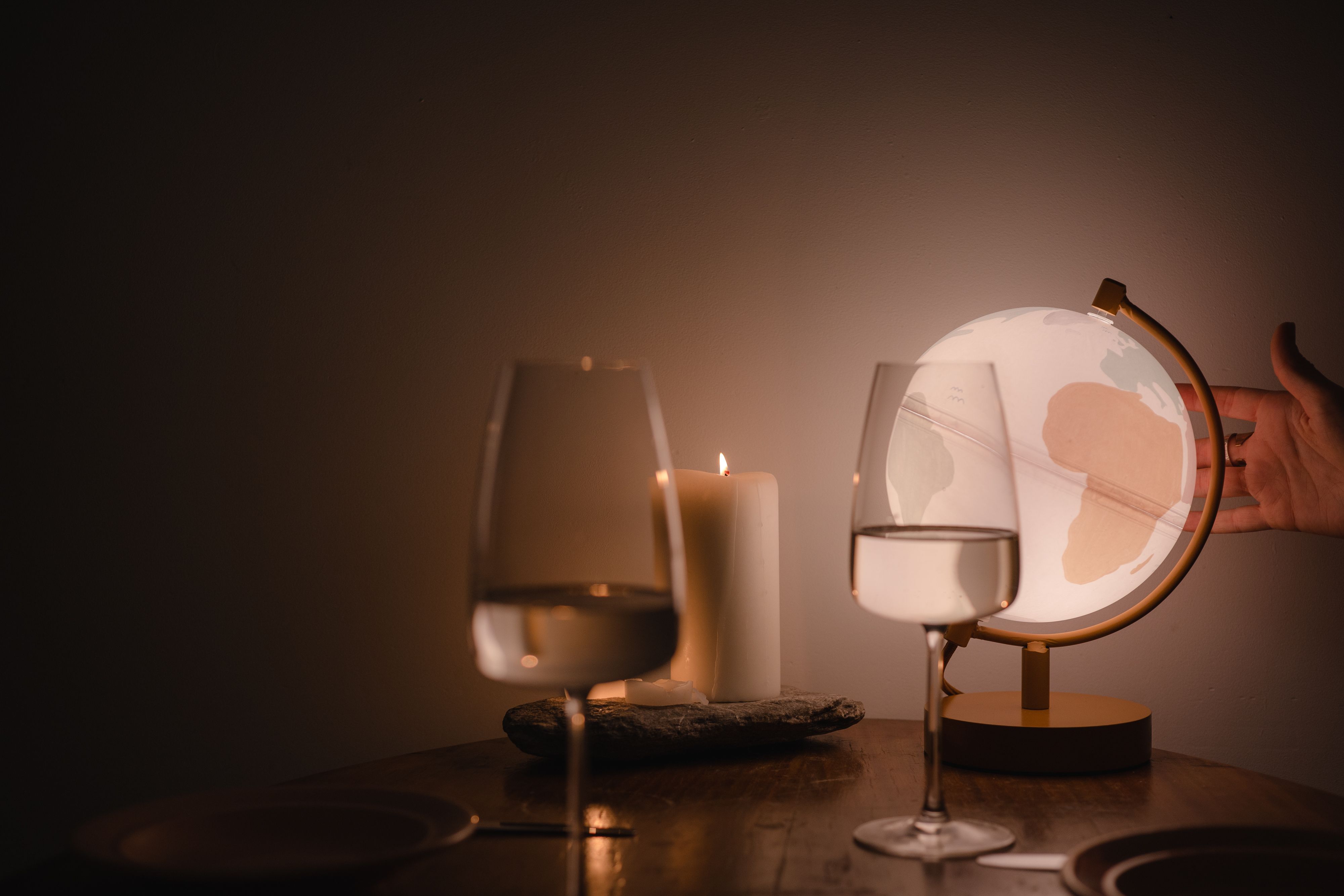
A World Tour of Wine: 12 Wine Regions You Can Visit Without Leaving Your Sofa
Let’s be brutally honest for a moment. As much as we all love the idea of a 90-night grand voyage with Fred. Olsen, a lavish river cruise through the heart of Europe or a perfectly organised wine holiday where somebody else deals with the luggage, sometimes the bank balance - or the prospect of airport security - violently disagrees.
There is also the small matter of getting through the airport without being trapped behind someone who has apparently never encountered a passport before.
But who needs to cram their life into a wildly overpriced suitcase when you can traverse the globe entirely from the comfort of your sofa?
Thanks to the magic of global wine production, you can embark on a world tour one bottle at a time. From the Sauvignon Blanc vineyards of New Zealand to the volcanic slopes of Santorini, the high-altitude vineyards of Argentina and the ancient wine valleys of Portugal, the world is effectively one enormous wine list.
And unlike an actual world tour, there is no jet lag.
There is no lost luggage.
There is no airport transfer driver holding a piece of paper with your name spelt incorrectly.
There is, however, the possibility of an increasingly impressive collection of empty bottles in the recycling.
Let’s pack our digital bags and let our SavvySipper insights do the heavy lifting.
Why Explore Wine Regions From Around the World?
Wine is one of the easiest ways to travel without actually travelling.
Every bottle carries something of its origin with it. Climate, soil, grape variety, winemaking tradition, altitude, geography and local culture all influence what eventually ends up in your glass.
That means you can learn a remarkable amount about a country simply by drinking its wine.
New Zealand gives you intensely aromatic Sauvignon Blanc shaped by a cool maritime climate.
Argentina offers high-altitude Malbec grown beneath the Andes.
South Africa combines Old World winemaking traditions with New World confidence.
France gives you centuries of appellation rules, famous estates and wine labels that occasionally require a small degree in medieval geography to decipher.
Portugal offers ancient grape varieties, dramatic river valleys and exceptional value.
And then there are the regions that are quietly becoming more exciting every year.
So, pour yourself something appropriate and let’s begin.
Stop 1: Marlborough, New Zealand
We begin our journey as far away from the miserable British drizzle as geographically possible.
Marlborough, at the top of New Zealand’s South Island, put the country firmly on the international wine map with its unmistakable Sauvignon Blanc.
The style is famous for its explosive aromatics, with passionfruit, citrus, gooseberry, fresh herbs and that unmistakable freshly-cut-grass character.
It is not shy.
It does not quietly introduce itself and wait to be invited into the conversation.
It kicks the door open.
Marlborough Sauvignon Blanc has become one of the world's most recognisable wine styles, and the region is now one of the defining wine regions of New Zealand.
While Sauvignon Blanc dominates its international reputation, Marlborough also produces Pinot Noir, Chardonnay and other varieties worth investigating.
And the region's cool maritime climate helps produce wines with plenty of freshness and acidity.
For a wine that works brilliantly with seafood, salads, goat's cheese or simply ignoring your work emails, it is difficult to go wrong.
Just remember to pair it properly.
Stop 2: Mendoza, Argentina
Next, we cross the Pacific to the high-altitude vineyards of Argentina, where the Andes provide a rather spectacular backdrop and Malbec has found its natural second home.
Mendoza is the undisputed heavyweight of Argentine wine and one of the world's most important regions for Malbec.
Malbec originated in France, where it remains part of the traditional Bordeaux blend and is strongly associated with Cahors. In Argentina, however, it found a combination of climate, altitude and conditions that allowed it to become something considerably bigger.
Argentine Malbec can be rich, dark and generous, with flavours of plum, blackberry, violet, cocoa and spice, often supported by smooth tannins.
And then there is the altitude.
Many vineyards around Mendoza sit at impressive elevations, with intense sunlight during the day and cooler temperatures at night. Those temperature differences can help grapes retain acidity while developing ripe fruit character.
The result is one of the great modern wine success stories.
If you are ordering steak and not drinking Malbec, nobody is legally allowed to arrest you.
But someone at the table may quietly question your judgement.
Stop 3: Stellenbosch, South Africa
Time to head across the Atlantic to the staggeringly beautiful Cape Winelands.
Stellenbosch is one of South Africa's best-known wine regions and a fascinating meeting point between Old World tradition and New World confidence.
The region is particularly well known for Cabernet Sauvignon, but its wine portfolio is much broader.
Chenin Blanc is particularly important, producing wines that can range from fresh and mineral to rich, textured and oak-influenced.
South Africa also has its own famously divisive red grape: Pinotage.
Created in South Africa in the 1920s by crossing Pinot Noir and Cinsault, Pinotage has developed a reputation for being distinctive, powerful and occasionally rather eccentric.
Depending on the producer and style, it can offer dark fruit, spice, smoke and savoury characteristics.
It is the sort of wine that does not necessarily ask whether you like it.
It simply arrives.
Stellenbosch also demonstrates why South Africa deserves far more attention from wine drinkers looking beyond the traditional European powerhouses.
Stop 4: Bordeaux, France
We finally drop anchor in the motherland of wine snobbery.
Bordeaux is the grand old dame of the wine world, famous for its gravelly soils, aristocratic châteaux, long history and price tags that can occasionally make your eyes water before you have even tasted the wine.
Bordeaux is particularly famous for its blends, with Cabernet Sauvignon, Merlot and Cabernet Franc among the key varieties.
The Left Bank and Right Bank have their own distinctive traditions, and understanding that difference can make navigating a Bordeaux wine list considerably less intimidating.
It is also a useful reminder that wine regions are about far more than individual grapes.
In Bordeaux, the name of the estate, appellation and location can tell you a great deal about what is inside the bottle.
Of course, all that history comes at a price.
When navigating a French wine list, always use SavvySipper's margin calculator to make sure your romantic French dinner does not accidentally become a small corporate acquisition.
Stop 5: Tuscany, Italy
Now we head south-east to one of the most beautiful and recognisable wine regions in Europe.
Tuscany is the home of Sangiovese, the grape behind some of Italy's most famous wines, including Chianti Classico and Brunello di Montalcino.
The region's rolling hills, cypress-lined roads and medieval villages have become practically synonymous with wine tourism.
Sangiovese is naturally high in acidity and tannin, making it a superb partner for food.
Expect red cherry, herbs, earthy notes and savoury spice, with more serious examples developing considerable complexity with age.
And then there are the so-called Super Tuscans.
These wines famously pushed against traditional Italian classification rules by using varieties and techniques that did not always fit neatly into the established system.
The result was a revolution that helped demonstrate that Italian wine could innovate without abandoning its sense of place.
In other words, even the Italians occasionally decide that rules are merely suggestions.
Stop 6: Rioja, Spain
Next stop: northern Spain.
Rioja is one of Spain's most famous wine regions and one of the safest places to begin if you want to explore Spanish wine beyond Sangria.
The region is best known for Tempranillo, which can produce wines ranging from fresh and fruity to deeply complex, oak-aged examples capable of developing beautifully over time.
Traditional Rioja is particularly associated with ageing in oak, giving many wines flavours of vanilla, spice, dried fruit and leather alongside the underlying red fruit.
There are also modern styles that place greater emphasis on fruit, freshness and individual vineyard character.
Rioja is an excellent food wine, particularly alongside grilled meats, tapas, roasted vegetables and the sort of meal that somehow begins at 8pm and ends several hours later.
Spain does not appear to have received the memo about rushing dinner.
Stop 7: Napa Valley, California
Now we head to California and one of the most famous wine regions in the New World.
Napa Valley has become almost synonymous with premium American wine, particularly Cabernet Sauvignon.
The region's warm climate, varied soils and diverse microclimates allow producers to create powerful, concentrated wines with considerable ageing potential.
Napa also played a hugely important role in changing global perceptions of New World wine.
The region's success demonstrated that serious, age-worthy Cabernet Sauvignon did not need to come from France.
Of course, Napa's reputation means prices can be rather enthusiastic.
There are plenty of excellent bottles that do not require a small inheritance, but if you are ordering Napa Cabernet in a restaurant, checking the markup is probably sensible.
There is adventurous.
And then there is financially reckless.
SavvySipper prefers the former.
Stop 8: Barossa Valley, Australia
We are heading back down under, this time to South Australia.
The Barossa Valley is one of Australia's most famous wine regions and has built an international reputation around powerful Shiraz.
Barossa Shiraz is generally richer and more opulent than the cool-climate styles found in some other parts of Australia, offering dark fruit, spice, chocolate and generous texture.
The region is also famous for old vines, including exceptionally old examples of Shiraz and Grenache.
There is a wonderfully unapologetic quality to Barossa wine.
It does not particularly care whether you were planning to have "just one glass".
It has other plans.
Stop 9: Douro Valley, Portugal
Now we travel to Portugal, where the landscape becomes almost as impressive as the wine.
The Douro Valley is famous around the world for Port, but it would be a mistake to assume that fortified wine is the only reason to visit.
The region also produces excellent dry red and white table wines, often from traditional Portuguese varieties including Touriga Nacional, Touriga Franca and Tinta Roriz.
The vineyards are planted along steep terraces carved into the dramatic hillsides surrounding the Douro River.
It is one of those wine regions where the landscape immediately explains why the wine feels distinctive.
The Douro also offers excellent value compared with some of Europe's more fashionable wine regions.
Which is particularly handy when your wine holiday is taking place entirely from the sofa and you have accidentally spent the travel budget on bottles.
Stop 10: Mosel, Germany
For our next stop, we head north to Germany and the spectacular Mosel Valley.
If you think German wine is simply sweet Riesling in a suspiciously tall bottle, it is time for an update.
The Mosel is one of the world's great Riesling regions, producing wines that can range from bone-dry to intensely sweet.
The steep vineyard slopes along the Mosel River create challenging growing conditions but also provide excellent exposure to sunlight.
Riesling from the Mosel can be incredibly aromatic, with citrus, stone fruit, floral notes and an almost electric acidity.
And because Riesling retains its acidity so well, even sweeter styles can remain beautifully balanced rather than simply tasting like liquid pudding.
For seafood, spicy food and lighter dishes, dry German Riesling can be an absolute revelation.
It is also proof that white wine does not have to shout to make an impression.
Stop 11: Santorini, Greece
We are off to the Aegean next.
Santorini is not only famous for sunsets, whitewashed buildings and people taking approximately 400 photographs of the same blue dome.
It is also home to one of the world's most distinctive wine-growing environments.
The island's volcanic soils and dry, windy climate create challenging conditions for grape growing, but the indigenous Assyrtiko grape thrives here.
Santorini Assyrtiko can be intensely dry, mineral, citrus-driven and saline, with remarkable acidity.
It is an extraordinary match for seafood, grilled fish and salty Mediterranean dishes.
There is also something rather satisfying about drinking a wine from an island where the vines have to survive conditions that would make most British gardeners reach for a cup of tea and give up.
Stop 12: Willamette Valley, Oregon
Our final stop takes us to Oregon in the Pacific Northwest of the United States.
Willamette Valley has become one of America's most respected regions for cool-climate Pinot Noir.
The region's relatively cool conditions allow Pinot Noir to develop freshness and aromatic complexity without losing its delicate character.
Alongside Pinot Noir, the valley is increasingly known for Chardonnay and other cool-climate varieties.
For anyone who loves Burgundy but finds Burgundy pricing somewhat difficult to justify to their bank manager, Oregon Pinot Noir can be an extremely interesting alternative.
It is not Burgundy.
That is rather the point.
It has its own climate, soils and regional identity.
And it is another reminder that great Pinot Noir can come from considerably more places than the Côte d'Or.
Bonus Stop: Central Otago, New Zealand
Because twelve destinations clearly was not enough.
Central Otago sits at the southern end of New Zealand's South Island and has developed a global reputation for Pinot Noir.
It is one of the world's southernmost wine regions and has a distinctive continental climate, with warm days and cool nights during the growing season.
The resulting Pinot Noir can be bright, aromatic and concentrated, with ripe red and dark fruit alongside savoury and spicy notes.
If Marlborough demonstrates what New Zealand can do with Sauvignon Blanc, Central Otago demonstrates that the country is capable of considerably more.
Bonus Stop: Barolo, Piedmont, Italy
For serious red wine lovers, we cannot possibly finish a world wine tour without a detour to Piedmont.
Barolo is one of Italy's most prestigious wines, made from Nebbiolo in the hills around the town of Barolo.
Nebbiolo is a fascinating grape because it can combine relatively pale colour with serious tannin, acidity and ageing potential.
Young Barolo can be firm and powerful, while mature examples can develop complex aromas of dried flowers, cherries, herbs, earth, spice and that unmistakable savoury character that makes wine enthusiasts start using words such as "tertiary" at dinner.
You do not have to join them.
You can simply drink the wine.
Bonus Stop: The Douro's Neighbour - Alentejo, Portugal
If Portugal has caught your attention, take another look at Alentejo.
This broad region in southern Portugal is known for warm conditions and a wide range of grape varieties.
Alentejo produces generous, fruit-forward reds as well as increasingly interesting whites, often offering impressive quality at prices that are considerably more approachable than some of Europe's famous appellations.
It is precisely the sort of region that savvy wine drinkers should keep an eye on.
Less fuss.
Less famous-name premium.
Plenty of good wine.
Bonus Stop: Hawke's Bay, New Zealand
We are going back to New Zealand because apparently one stop was not enough.
Hawke's Bay is one of New Zealand's leading wine regions and is particularly well known for Syrah, Cabernet Sauvignon, Merlot and Chardonnay.
The region's warmer climate allows producers to make richer red wines while retaining the freshness associated with New Zealand.
It is an excellent reminder that New Zealand wine extends considerably beyond Sauvignon Blanc.
Although, to be fair, Sauvignon Blanc has done quite enough work for the national economy already.
Bonus Stop: Margaret River, Australia
Western Australia gives us Margaret River, one of the country's most highly regarded premium wine regions.
Margaret River is particularly famous for Cabernet Sauvignon and Chardonnay, with the maritime climate helping producers create wines that combine ripe fruit with freshness and structure.
The region is a useful counterpoint to the richer styles associated with Barossa Valley.
Australian wine is not one single style.
It is an enormous country with remarkably diverse climates and growing conditions.
Margaret River proves that Australia can produce elegant, restrained and age-worthy wines just as convincingly as it can produce big, powerful Shiraz.
Bonus Stop: Colchagua Valley, Chile
Chile deserves its own passport stamp.
Colchagua Valley has developed an international reputation for powerful reds, particularly Cabernet Sauvignon and Carmenère.
Carmenère is especially interesting because the grape was once widely mistaken for Merlot in Chile before its identity was correctly established.
Today, Chile is one of the world's most important producers of Carmenère.
The wines can be rich and fruit-driven, often with dark fruit, spice, herbs and soft tannins.
And, as with Argentina, Chile's combination of geography, altitude and relatively dry conditions gives it a distinctive place in the New World wine landscape.
How to Plan Your Own Sofa-Based Wine Tour
The beauty of a wine world tour is that you do not need to drink twelve bottles in one evening.
Please do not.
Instead, make it a series.
Pick one region each week.
Start with a bottle that represents the region's signature style.
Learn a little about the climate and grape variety.
Then compare it with another bottle from the same region or a different part of the world.
For example, compare Marlborough Sauvignon Blanc with Sancerre.
Compare Mendoza Malbec with Cahors.
Compare Napa Cabernet Sauvignon with Bordeaux.
Compare Central Otago Pinot Noir with Burgundy.
Compare Barossa Shiraz with Northern Rhône Syrah.
Suddenly, wine stops being a collection of intimidating labels and becomes a map.
And a rather enjoyable map at that.
Why Wine Region Matters
The more wine you taste, the more obvious it becomes that geography matters.
The same grape variety can taste remarkably different depending on where it is grown.
Climate influences ripening.
Soils influence water availability and vine growth.
Altitude influences temperature and sunlight.
Coastal conditions can moderate heat.
Mountain ranges can create rain shadows.
And centuries of local winemaking traditions influence how grapes are harvested, fermented, aged and blended.
That is why exploring wine regions is so rewarding.
You are not simply tasting different grapes.
You are tasting different places.
How to Avoid Getting Ripped Off on Your Wine World Tour
There is one small problem with discovering all these wonderful wine regions.
Someone has to sell you the bottles.
And some restaurants have rather creative ideas about what constitutes a reasonable markup.
A bottle that costs a perfectly respectable amount at retail can become eye-wateringly expensive once it appears on a restaurant list.
That does not automatically mean the restaurant is behaving badly. Restaurants have staff, rent, glassware, storage, wastage, service and a frankly astonishing number of costs that customers do not see.
But understanding the difference between retail price and restaurant price is still extremely useful.
Before ordering, use SavvySipper's markup and margin tools to understand what you are actually paying for the bottle.
Because there is adventurous wine drinking.
And there is paying £90 for a bottle you could have bought for £18 while the person at the next table quietly drinks the same thing.
We know which one we prefer.
The Ultimate Wine World Tour Checklist
If you want to turn this into a proper drinking challenge, here is your itinerary:
- Marlborough, New Zealand - Sauvignon Blanc
- Mendoza, Argentina - Malbec
- Stellenbosch, South Africa - Chenin Blanc or Pinotage
- Bordeaux, France - Cabernet Sauvignon and Merlot blends
- Tuscany, Italy - Sangiovese
- Rioja, Spain - Tempranillo
- Napa Valley, USA - Cabernet Sauvignon
- Barossa Valley, Australia - Shiraz
- Douro Valley, Portugal - Port or dry red blends
- Mosel, Germany - Riesling
- Santorini, Greece - Assyrtiko
- Willamette Valley, USA - Pinot Noir
- Central Otago, New Zealand - Pinot Noir
- Piedmont, Italy - Nebbiolo
- Alentejo, Portugal - regional red blends
- Hawke's Bay, New Zealand - Syrah or Bordeaux varieties
- Margaret River, Australia - Cabernet Sauvignon
- Colchagua Valley, Chile - Carmenère or Cabernet Sauvignon
That is eighteen wine destinations.
And still considerably cheaper than the cruise.
The Savvy Verdict
The best part of a liquid world tour?
No jet lag.
No lost luggage.
No airport queues.
No hotel minibar charging £9 for a bottle of water.
And if the destination disappoints you, you can simply pull the cork on another country.
More importantly, exploring the world's wine regions is one of the easiest ways to make your drinking life more interesting.
You start with a bottle of Sauvignon Blanc from Marlborough and suddenly find yourself wondering what else New Zealand produces.
You try Mendoza Malbec and discover the extraordinary influence of altitude.
You open a bottle of Greek Assyrtiko and realise white wine can taste completely different from the Chardonnay you normally buy.
You try a German Riesling and discover that sweetness and acidity can coexist without the wine tasting like a children's birthday party.
You discover Portuguese reds, Chilean Carmenère, South African Chenin Blanc, Oregon Pinot Noir and Italian Nebbiolo.
Before long, your wine rack has effectively become a passport.
And unlike an actual passport, it does not need renewing every ten years.
So pour yourself something from somewhere you've never tried before.
Explore the region.
Learn the grape.
Check the price.
And, most importantly, enjoy the journey.
For more wine discoveries, expert insights and tools designed to help you make smarter choices when buying and ordering wine, explore The Pour by SavvySipper.
Because you do not need a first-class ticket to travel the world.
You just need a decent wine list.
And preferably someone else to do the washing up.